Static vs. Dynamic QR Codes: Which One Does Your Business Actually Need?
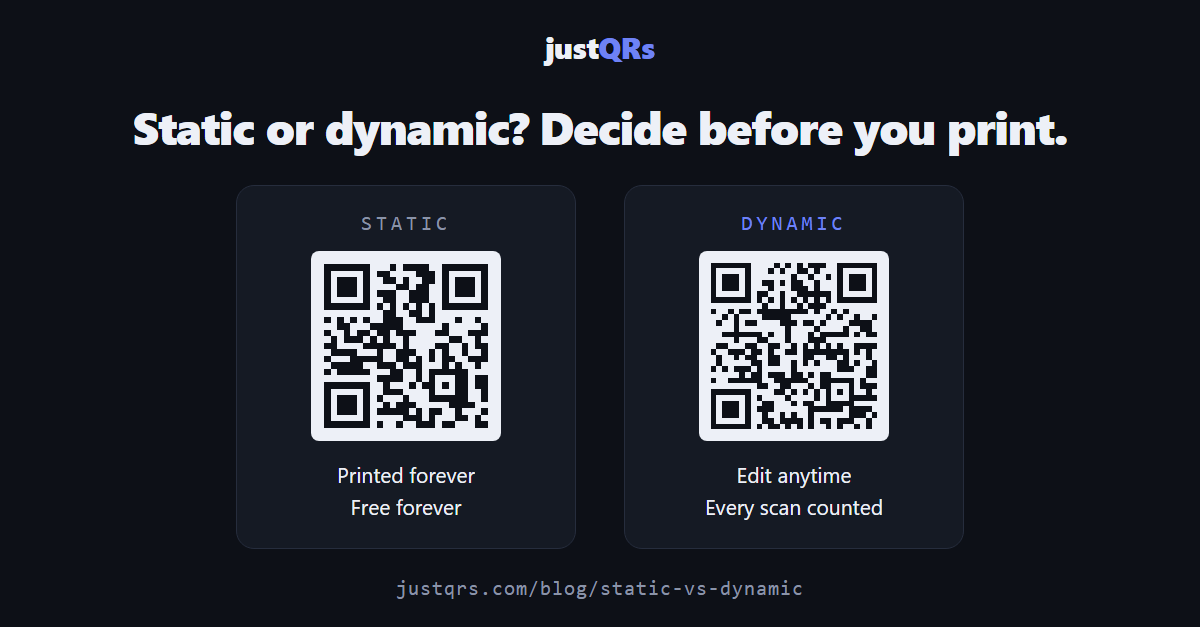
You printed 500 menus in March. The PDF they point to changed in April.
That's the whole static-versus-dynamic question in two sentences, and it's worth settling before anything goes to the printer — because the two kinds of QR code behave very differently the day something changes.
What a static QR code actually is
A static QR code encodes your content — a web address, a Wi-Fi password, contact details — directly in the pattern itself. The squares are the data. That gives static codes three properties you can build on:
- They work forever. There's no service between the scanner and your content, so there's nothing to expire, no account to lapse, no company that can break your code by changing its terms. If the thing it points to still exists, the code still works.
- They cost nothing. Encoding data into a pattern is just math.
- They can't be changed. The moment a static code is printed, it's a commitment. New URL? New code — and a reprint.
That last property is the one that bites. A QR code on paper, signage, or packaging is a printed promise, and a static code keeps that promise exactly as written — typo and all.
What a dynamic QR code actually is
A dynamic QR code encodes a short link instead of the destination itself. The scan goes to that link, and the link forwards to wherever you've currently pointed it. The pattern on paper never changes; the destination behind it can change as often as you like.
Routing scans through a link you control buys you two things:
- Editability. The menu moved, the promo ended, the form changed platforms — update the destination in a dashboard and every printed code follows instantly. Reprint nothing.
- Measurement. Because each scan passes through the link, it can be counted: when, from which country and city, on which device, OS, and browser. You learn whether the table tent outperforms the window sticker — with no tracking pixel on your site.
The trade-off is honest: a dynamic code depends on the service that hosts the link. That's why it's a paid product, and why it's worth choosing a provider you'd trust with a printed commitment.
A one-minute decision guide
Ask three questions about the code you're about to print:
- Will the destination ever change? A personal vCard or your Wi-Fi password — probably not: static is perfect. A menu, a promo, a signup form, an app link — assume it will: dynamic.
- How expensive is a reprint? A sheet of paper taped to a counter, cheap. Five hundred menus, a vehicle wrap, ten thousand product boxes — a reprint costs more than a year of any QR platform: dynamic.
- Do you need to know if anyone scans it? If the code is part of a campaign — posters, flyers, packaging, ads — scan counts are the difference between guessing and knowing: dynamic.
If you answered "no" three times, use a static code and pay nobody. Plenty of QR jobs are genuinely static jobs, and any service that pushes you to a paid code for a Wi-Fi card is selling you something you don't need.
One caution if you go static through a free online generator: make sure it encodes your actual URL, not a shortened redirect through the generator's own domain. Some "free" tools quietly route static codes through their servers — and when the free tier ends, so does your code. (A truly static code can't expire, because there's nothing in the middle.)
Where justQRs fits
justQRs does both, priced the way the decision guide above would suggest:
- Static QR codes are free forever. A free account gets the full designer — fifteen body patterns, twelve corner styles, gradients, logos, call-to-action frames — and unlimited PNG, SVG, and PDF downloads. No watermarks, no expiry, and the codes encode your destination directly, so they keep working whether or not you ever pay us.
- Dynamic QR codes are one flat subscription — $9.99/month or $89/year for 500 dynamic codes, scan analytics (thirteen months of raw scan events, aggregates kept forever), hosted landing pages for codes that need a page behind them, and five team seats.
- If you stop paying, your printed static codes keep working. Dynamic codes pause until you're back — they're stored, not deleted — and everything you designed stays yours.
A free justQRs account designs and downloads static QR codes forever — no watermarks, no expiry. And if you want codes you can edit and track, every feature is free for 7 days, no card required.
Need a QR code? Generate a static code free — no account — or see what dynamic codes cost.